
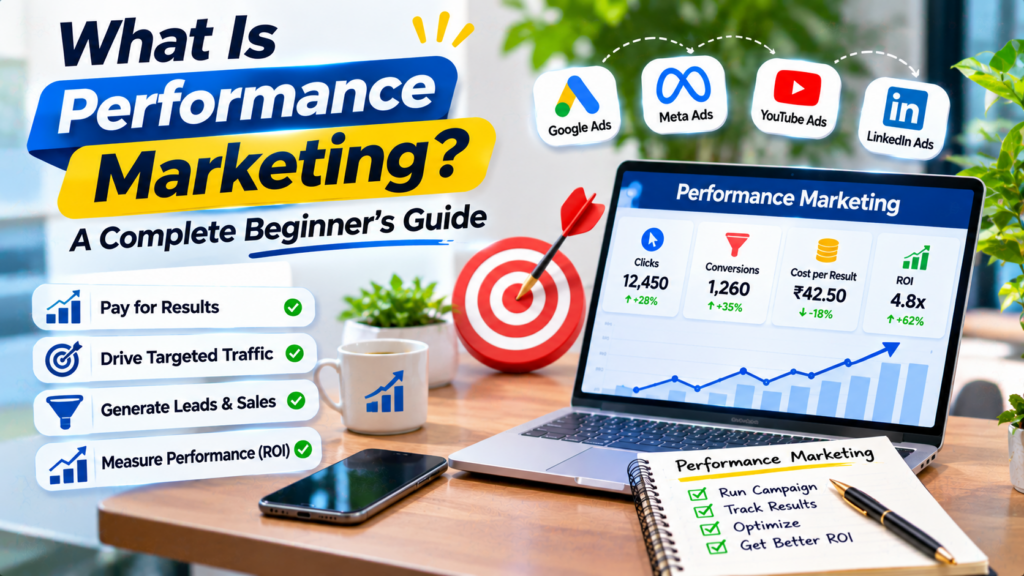
What Is Performance Marketing? A Complete Beginner’s Guide.
Introduction In today’s digital world, businesses are constantly looking for effective ways to reach customers, generate leads, and increase sales. Traditional advertising focuses on promoting products and building brand awareness, but businesses also want measurable results from their marketing investments. This is where Performance Marketing comes in. Performance Marketing is a digital marketing strategy in which businesses pay for specific measurable actions, such as clicks, leads, conversions, app installations, or sales. It helps companies understand how their advertising campaigns are performing and whether they are getting good returns on their investment. In this beginner’s guide, we will understand what performance marketing is, how it works, its different channels, benefits, and career opportunities. 1. What Is Performance Marketing? Performance Marketing is a type of online advertising where advertisers focus on measurable results rather than simply displaying advertisements. Businesses can track important activities such as website visits, clicks, leads, purchases, and conversions. For example, imagine you own an online clothing store and want to sell 100 T-shirts. You run a Facebook or Instagram advertising campaign targeting people interested in fashion. You can track: This information helps you understand whether your advertising campaign is successful. 2. How Does Performance Marketing Work? Performance Marketing follows a simple process that helps businesses achieve specific marketing goals. Step 1: Set Marketing Goals First, businesses decide what they want to achieve, such as generating leads, increasing website traffic, or selling products. Step 2: Select Advertising Platforms Marketers choose platforms such as Google Ads, Facebook Ads, Instagram Ads, or LinkedIn Ads depending on their target audience. Step 3: Create Advertisements They create attractive advertisements using images, videos, headlines, and call-to-action buttons. Step 4: Launch Campaigns The advertisements are published to reach the selected audience. Step 5: Track Performance Marketers monitor clicks, impressions, conversions, leads, and advertising costs. Step 6: Optimize Campaigns Based on the results, marketers improve their advertisements, targeting, and budgets to achieve better performance. 3. Types of Performance Marketing Channels There are several channels businesses use to run performance marketing campaigns. 1. Search Engine Marketing (SEM) Search Engine Marketing involves promoting websites through paid advertisements on search engines like Google. For example, when someone searches for “Best Digital Marketing Agency in Mumbai,” sponsored results may appear at the top of Google. 2. Social Media Advertising Businesses use platforms such as Facebook, Instagram, and LinkedIn to promote their products and services. These platforms allow advertisers to target audiences based on interests, demographics, and other available targeting options. 3. Affiliate Marketing Affiliate Marketing is a strategy where individuals or publishers promote another company’s products and earn commissions when users complete specific actions, usually purchases. For example, a YouTube creator can promote a product using an affiliate link and earn a commission from successful sales. 4. Display Advertising Display advertising uses visual advertisements such as banners, images, and videos on websites and applications to attract potential customers. 5. Email Marketing Businesses use email campaigns to communicate with customers, promote products, share offers, and encourage purchases. 4. Important Performance Marketing Metrics Performance marketers use different metrics to measure the success of advertising campaigns. For example, if a business spends ₹10,000 on advertising and generates ₹40,000 in revenue, its ROAS is 4x. This means the business generates ₹4 in revenue for every ₹1 spent on advertising. 5. Benefits of Performance Marketing Performance Marketing offers several advantages to businesses: 6. Popular Performance Marketing Tools Some commonly used tools and platforms include: 7. How to Start a Career in Performance Marketing? Performance Marketing is a growing career option for people interested in advertising, analytics, and digital marketing. Beginners can start by learning these skills: You can also create sample advertising campaigns and practice analyzing their performance to build a portfolio. Conclusion Performance Marketing is an effective digital marketing strategy that helps businesses achieve measurable results through online advertising. It allows companies to track their advertising expenses, understand customer behaviour, generate leads, and increase sales. From Google Ads and social media advertising to affiliate marketing and email campaigns, performance marketing provides several opportunities for businesses to grow online. For beginners, learning advertising platforms, marketing metrics, and campaign optimization is a great way to start a career in this field. Remember: Performance Marketing is not just about spending money on advertisements; it is about getting measurable results from every marketing investment.